
Last Updated on March 4, 2026 by asadsultan270@gmail.com
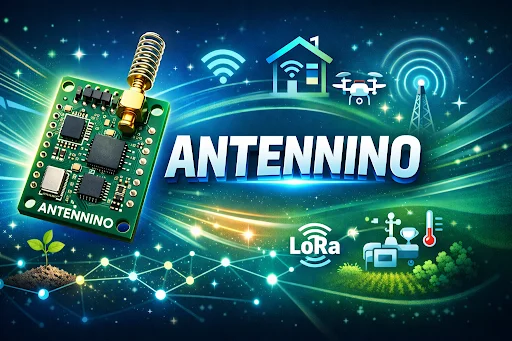
Antennino is a compact, Arduino-compatible board that integrates a microcontroller (commonly the ATmega328P) with an onboard radio transceiver (often the RFM69 family) and an antenna footprint — all packaged for low-power IoT use. In essence, it’s a deliberate blend of an Arduino-compatible antenna module and an easy-to-use prototyping board that removes the friction of pairing separate radios and microcontrollers. This integrated approach shortens development time for wireless sensor nodes and small remote devices.
Antennino’s appeal comes from solving three common pain points: power efficiency, compactness, and ease of integration. By combining a microcontroller and RF transceiver on one board with a built-in antenna or antenna connector, Antennino reduces component count, PCB area, and assembly effort — a big win for battery-powered sensor projects. Makers and small businesses appreciate that many Antennino variants are Arduino IDE compatible, enabling rapid prototyping without steep learning curves.
Typical use cases include environmental monitoring sensors, smart home automation nodes, remote sensor nodes for agriculture, and robotics communication systems. Its low power profile makes it ideal for deployment where long battery life is crucial. Whether you’re building a gateway, a LoRa/433MHz sensor node, or a compact wireless module for robotics, Antennino fits into many IoT ecosystems by simplifying the wireless layer.
RELATED: Goonierne 2: Meaning & Updates
Understanding Antennas and Wireless Communication Basics
How antennas work in wireless systems
Antennas convert electrical signals into radio waves and vice versa. In transmit mode the antenna radiates energy at RF (Radio Frequency), and in receive mode it collects radio waves and converts them back to electrical signals that the transceiver decodes. The effectiveness of an antenna is measured by parameters such as gain, bandwidth, and radiation pattern — all of which determine how well a device communicates over distance and through obstacles. Practical antenna choices directly affect real-world performance of small wireless communication devices.
Radio frequency (RF) communication explained
RF communication uses specified frequency bands (e.g., 433 MHz, 868 MHz, 915 MHz) for wireless data transfer. Boards like Antennino often pair with transceivers such as the RFM69, optimized for sub-GHz operation and low power consumption. The transceiver and antenna together govern range, data rate, and reliability. When designing a wireless sensor network, you balance transmit power, duty cycle, and antenna characteristics to meet range and battery life goals.
Role of small antennas like Antennino in modern devices
Mini antennas and integrated antenna boards (like Antennino) prioritize portability and low cost while still delivering respectable range for IoT tasks. Though smaller antennas often have lower gain than larger external ones, careful PCB antenna design or a U.FL connector for an external LoRa antenna helps maintain performance. For many applications — smart home nodes or environmental sensors — a compact wireless module outperforms expectations when used with proper placement and tuning.
The Technology Behind Antennino
Design and structure of Antennino
At the heart of many Antennino boards sits the ATmega328P microcontroller, a widely used chip in Arduino ecosystems known for low-power modes and familiarity among developers. Paired with an RFM69 RF transceiver, the board is laid out so the antenna either sits on the PCB (a printed trace antenna) or is accessible through a U.FL/SMA connector for external antennas. This arrangement minimizes RF losses caused by poor cabling and keeps the board footprint compact.
Materials used in Antennino manufacturing
Typical Antennino PCBs use FR-4 substrate with controlled copper pour for ground planes and tuned antenna traces. Components include the ATmega328P, the RFM69 or similar RF module, power management ICs (for battery operation), and sometimes crypto chips for secure communication. Antenna manufacturing pays attention to soldermask clearance and matching networks (inductors and capacitors) so the antenna is impedance matched to the transceiver.
Signal transmission and reception mechanism
The RF transceiver (RFM69) modulates digital data into RF signals which the antenna radiates. In receive mode, the antenna picks up RF energy and the transceiver demodulates it back into bits. Engineers monitor RSSI (Received Signal Strength Indicator) and packet success rates to evaluate link health. For reliable communication, proper frequency selection, duty cycling, and acknowledgement schemes are implemented to maximize battery life.
Types of Antennino and Variations
Mini antenna modules
Mini antenna versions prioritize the smallest possible footprint. They often use a PCB trace antenna tuned for a specific frequency (e.g., 433 MHz). These are perfect for compact sensor nodes where an external whip antenna is impractical. While compact, trace antennas must be carefully designed to avoid detuning from nearby metal or enclosure effects.
IoT-compatible Antennino devices
Some Antennino models are explicitly marketed as IoT antenna devices with battery-friendly regulators, RTCs, and deep sleep support. These boards are tailored for remote sensor nodes that wake, transmit small packets, and sleep again — maximizing lifetime on small batteries. Arduino IDE compatibility means rapid porting of existing sensor libraries and protocols e.g., MySensors, LoRa stacks.
Directional vs omnidirectional Antennino designs
Design choices influence radiation patterns: omnidirectional antennas spread signal in all horizontal directions, ideal for mesh nodes; directional antennas focus energy in one direction, boosting range toward a gateway or base station. Antennino variants may offer connectors for an external directional antenna when long-range, line-of-sight links are required. Choose the design based on whether you need broad coverage or targeted long-range communication.
Key Features of Antennino
Compact and lightweight design
Antennino boards are intentionally compact, minimizing enclosure size for wearables, trackers, and small sensor boxes. A small wireless communication device simplifies deployment and reduces shipping/installation costs for distributed sensor networks. The reduced size is especially valuable in smart robotics connectivity where space is at a premium.
Low power consumption
Using power-savvy microcontrollers like the ATmega328P and duty-cycled transceivers (RFM69), Antennino can achieve long battery life. Energetic savings come from sleep modes, low quiescent regulators, and efficient radio protocols. For remote sensor nodes, this means months or years of operation on small battery packs depending on transmit frequency and sensor sampling rate.
High signal efficiency
Though small, Antennino’s integrated antenna and tuned RF front end are designed for efficient radiation at the chosen frequency. When designers provide a matched antenna or offer an external antenna connector, the effective system performance rivals larger setups. Proper tuning and placement are crucial to get the best antenna gain and bandwidth.
Compatibility with embedded systems
Because Antennino is Arduino-compatible, it sits naturally in embedded systems projects. The ATmega328P and industry standard serial or SPI interfaces enable connection to sensors, gateways, and host controllers. The ability to program with the Arduino IDE reduces ramp-up time for teams and hobbyists alike.
Advantages of Using Antennino
Improved wireless connectivity
Antennino integrates the RF chain and microcontroller closely to reduce losses and interference that can occur with loose wiring. For many applications this results in more reliable packet delivery and better RSSI readings compared to ad-hoc assemblies. This streamlined architecture raises confidence when deploying large wireless sensor networks.
Cost efficiency
By reducing the need for separate radio shields, connectors, and cabling, Antennino lowers bill-of-materials and assembly costs. For volume deployments in agriculture or industrial monitoring, these savings compound significantly. Open hardware and inexpensive RFM69 transceivers also help keep costs down.
Easy integration into DIY projects
Antennino simplifies prototyping. Its Arduino IDE compatibility plus common headers lets hobbyists plug in sensors and test prototypes quickly. Whether creating a smart home automation sensor or an environmental monitoring device, Antennino reduces the time from concept to working prototype.
Ideal for IoT and smart devices
For IoT deployments where power, cost, and size matter, Antennino sits at a sweet spot: small wireless antenna capabilities with embedded microcontroller support. These boards are practical choices for smart agriculture, distributed environmental monitoring sensors, and compact robotics communication systems.
Applications of Antennino in Real Life
Smart home automation
Antennino nodes can serve as switches, sensors, or actuators in smart homes. Their small size lets them sit behind light switches, within thermostats, or inside motion sensors. Pairing with gateways allows robust home automation networks without the complexity of Wi-Fi power demands.
Environmental monitoring systems
Deploy Antennino boards with temperature, humidity, and air-quality sensors to create low-power environmental monitoring sensors that run on batteries for extended periods. These networks are common in smart agriculture deployments and remote weather monitoring where mains power is unavailable.
Robotics and remote control projects
Robots benefit from compact wireless modules for telemetry and control. Antennino’s low latency and simple integration make it suitable for robot-to-robot communication or robot-to-gateway links where portability and reliability matter.
Wireless sensor networks
Large scale wireless sensor networks (WSNs) — used in industry, agriculture, and conservation — rely on many remote sensor nodes communicating efficiently. Antennino-style nodes simplify deployment, and with proper network topology (mesh vs star) and gateway planning, they enable scalable, battery-efficient WSNs.
Antennino in IoT and Smart Technology
Role in Internet of Things ecosystems
Antennino functions as both sensor endpoint and communication module in IoT ecosystems. It interfaces with cloud gateways or local servers and participates in protocols used by IoT platforms. Its low-power operation makes it a solid choice for devices that must operate unattended for long durations.
Communication between sensor nodes
Nodes equipped with Antennino typically communicate with a central gateway or form mesh networks depending on chosen firmware. RSSI and link quality metrics help determine routing and retransmission strategies to ensure reliable data collection. Properly tuned, these networks can handle hundreds of nodes.
Antennino in smart agriculture
Smart agriculture uses remote sensor nodes for soil moisture, temperature, and crop health monitoring. Antennino’s compact wireless module makes it easy to place nodes throughout a field; when paired with LoRa or sub-GHz transceivers, data can be aggregated to a central gateway several kilometers away (line-of-sight), enabling actionable insights for irrigation and fertilization.
How to Use Antennino in DIY Projects
Setting up Antennino with microcontrollers
To begin, connect your Antennino to a USB-to-serial adapter (if it doesn’t have onboard USB) and configure the Arduino IDE for the ATmega328P clock speed and bootloader. Use available libraries for RFM69 to handle packet formation, encryption, and retries. Many community guides for RFM69 integration exist to accelerate setup.
Programming with development platforms
Because Antennino is Arduino-friendly, you can program it with the Arduino Integrated Development Environment (Arduino IDE). Load sensor drivers, configure the radio frequency, and write power-management routines to sleep between transmissions. This accessibility lowers the barrier for makers and small teams to produce stable firmware.
Testing signal performance
After assembly, test RSSI, packet loss, and latency across real distances and in intended environments. Use a simple gateway and node pair to quantify range with the onboard antenna, then test with an external LoRa or directional antenna if longer range is required. Tuning antenna placement and enclosure materials can dramatically improve results.
Performance Optimization for Antennino
Improving signal strength
To boost range, consider an external antenna via U.FL/SMA, verify antenna matching, and use a higher-gain directional antenna for point-to-point links. Ensure the antenna is clear of ground planes and metal enclosures that detune it. Correct quarter-wave lengths for your frequency (e.g., ~6.5″ for 433 MHz) are crucial if using a wire whip.
Reducing interference
Choose less crowded RF bands when possible, and use frequency hopping or channel selection to avoid noisy neighbors. Software measures like acknowledgements and retransmissions help—but hardware choices (shielding, matching networks) play the larger role in a reliably performing system.
Proper placement techniques
Place antennas vertically for omnidirectional coverage and avoid enclosing them in metal boxes; if you must, add an external connector to place the antenna outside. Keep ground planes consistent and maintain recommended clearances around PCB antennas to prevent detuning.
Frequency tuning basics
Verify that the transceiver and antenna are tuned to the same frequency band. Use a VNA or simple antenna analyzer for precision tuning, or rely on manufacturer specifications for common boards. Mismatched frequency/impedance will cost you range and reliability.
Challenges and Limitations of Antennino
Signal range limitations
Small, integrated antennas often cannot match the absolute range of full-size external antennas. For long-range telemetry you may need an external LoRa antenna or higher transmit power (where regulations permit). Understand the trade-off: compactness vs raw range.
Environmental interference issues
Urban environments with concrete, metal, and competing RF sources can dramatically shorten range and increase packet loss. Field testing in the target environment is essential to set realistic expectations and adjust placement, antennas, or radio settings appropriately.
Hardware compatibility problems
Though many Antennino boards are Arduino IDE compatible, differences in clock speed, bootloader, or power pins can cause compatibility hiccups. Always consult the board documentation for exact settings and recommended libraries. Community firmware and compatibility guides (e.g., for RFM69) are valuable resources.
Antennino vs Traditional Antennas
Size and portability comparison
Antennino emphasizes integration: the antenna + controller + radio on one compact board. Traditional setups might combine an Arduino with a separate RF shield and external antenna — larger but potentially more flexible for upgrading antenna types. Antennino wins for portability and reduced wiring.
Performance differences
A well-tuned external directional antenna generally outperforms an integrated trace antenna in range. However, Antennino’s design often narrows this gap through optimized matching and lower RF path losses, making it “good enough” for many deployments while providing unmatched ease of use.
Cost and efficiency analysis
Integrated boards reduce components and assembly cost. For modest range needs, Antennino reduces overall system cost vs traditional multi-part assemblies. For highly specialized long-range links, investment in larger antennas and external transceivers may still be justified.
Future of Antennino Technology
AI-driven communication optimization
Future boards could integrate machine learning to adaptively switch channels, adjust transmit power, and predict interference — improving lifetime and reliability for sensor networks. Edge inference for RF optimization is already a research theme in smart antenna evolution. (General trend observation; see wireless research).
Smart antenna evolution
Expect tighter integration with multi-band support (LoRa + BLE + sub-GHz) and adaptive directional elements that can steer beams for better link budgets. This would enable small devices to reach farther with less power.
Growth of IoT hardware ecosystems
As the IoT ecosystem matures, Antennino-style boards will proliferate in verticals like precision agriculture, smart cities, and industrial monitoring — aided by improved power management and regulatory-friendly RF modules.
Buying Guide for Antennino Products
What to look for before purchasing
Check microcontroller (ATmega328P recommended for Arduino compatibility), transceiver (RFM69 vs LoRa), supported frequency bands, antenna type (onboard vs connector), power supply options, and community support. Documentation and example code are invaluable for faster development.
Quality vs price considerations
Pay attention to RF quality (matching network, trace layout) rather than just BOM cost. Low-cost boards can work well, but poorly executed antenna designs will underperform. For mission-critical deployments, invest in reputable manufacturers or modular designs that allow antenna upgrades.
Trusted manufacturers and brands
Look for boards and components from vendors with community support and clear documentation. Open hardware projects and established electronics retailers often provide the best combination of support and reliability, while marketplaces can contain variable quality.
RELATED: Ehi Vuoi Da Bere: Meaning & Song Story
Frequently Asked Questions
What is Antennino used for?
Antennino is used to create compact, low-power wireless nodes — for smart home automation, environmental monitoring, robotics communication, and general IoT sensor networks.
Is Antennino suitable for beginners?
Yes. Because many Antennino boards are Arduino IDE compatible and have community libraries for RFM69 and sensors, beginners can prototype quickly. Still, basic RF awareness (antenna placement and frequency legality) is useful.
How far can Antennino transmit signals?
Range depends on frequency, antenna type, transmit power, and environment. Integrated boards might provide tens to a few hundred meters in urban settings; with external directional antennas or LoRa variants, line-of-sight ranges can extend to kilometers. Field testing is the best way to determine real-world range.
Can Antennino use LoRa?
Some Antennino-style boards support LoRa modules or have variants designed for LoRa frequency bands, enabling long-range low-data-rate communication suitable for many IoT use cases. Confirm the board’s transceiver details before purchase.
Which transceiver is commonly used with Antennino?
The RFM69 RF transceiver family is often paired with Antennino boards for sub-GHz operation and low-power cryptography support; LoRa modules appear on LoRa-focused variants.
Summary
Antennino combines an Arduino-compatible microcontroller (ATmega328P), a proven RF transceiver (RFM69 or LoRa variants), and a compact antenna solution to create an accessible, low-power building block for IoT. It streamlines prototyping, reduces costs, and fits numerous real-world applications from smart homes to agricultural monitoring.
For makers and professionals building wireless sensor networks, Antennino represents an elegant, practical evolution in IoT hardware: the benefits of integration without sacrificing the flexibility needed for real deployments. With careful antenna design, smart placement, and good firmware practices, Antennino boards deliver high value for the price and are poised to remain essential tools in modern embedded wireless systems.